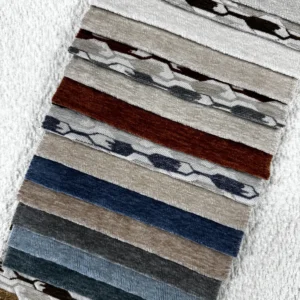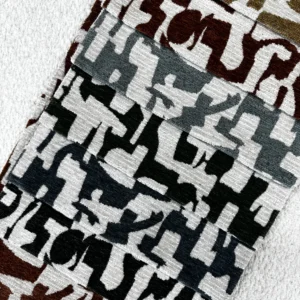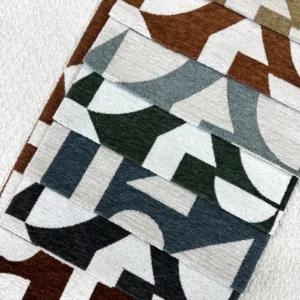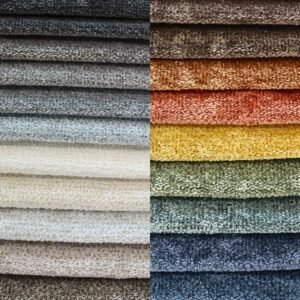
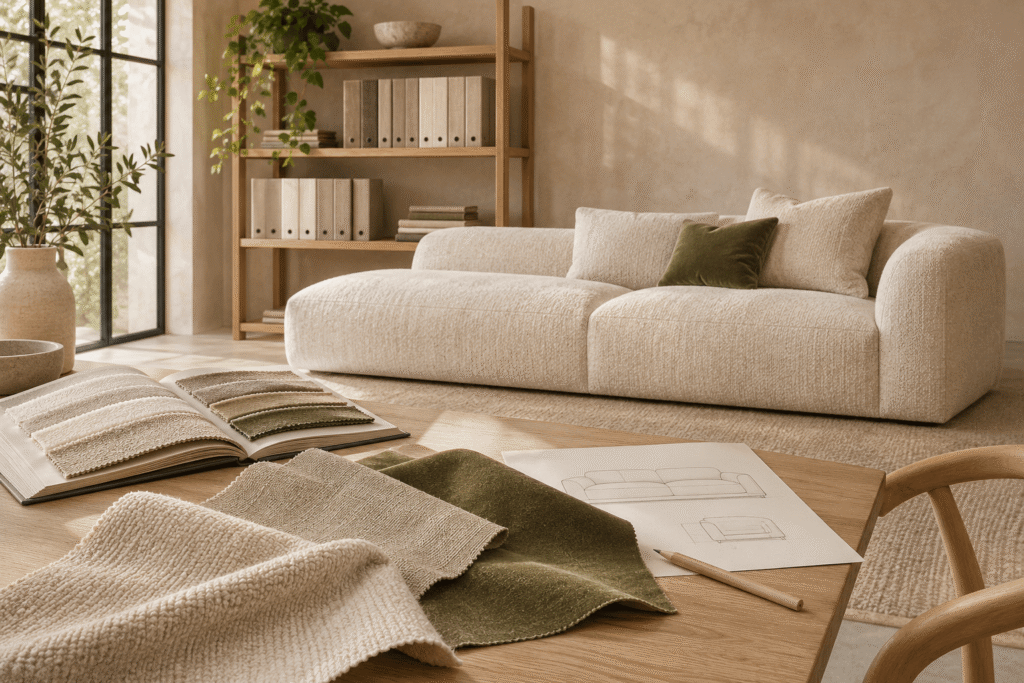
Choosing between chenille and velvet for your next sofa range? Start with the look your customers want, then compare the actual fabrics—not just their names. Chenille is often a useful starting point for visible texture; velvet is worth exploring when you want a pile surface with depth of colour. Neither name tells you the full construction, care requirements or performance.
For furniture manufacturers, importers and wholesalers, the useful question is: which article suits this furniture design, production process and market? Here is a practical way to narrow down your selection before ordering samples or bulk fabric.
Chenille and velvet at a glance
| Buying question | Chenille | Velvet |
|---|---|---|
| What look are you exploring? | A textured surface, from subtle plain looks to more visible woven designs. | A pile surface, with plain or decorative finishes and colour that may change with viewing direction. |
| What should your sample check focus on? | Yarn texture, softness, colour, backing and the appearance of the weave. | Pile direction, shading, feel, finish and backing. |
| What matters when cutting? | Check any pattern repeat or directional effect on the chosen article. | Plan pile direction consistently across panels; also check any pattern repeat. |
| Which is more durable? | There is no reliable winner by fabric name alone. Compare the selected articles, relevant test reports and intended use. | |
On a phone, swipe the table sideways to compare the columns. These are selection points, not performance guarantees for every fabric in a category.
1. Start with the furniture your buyer wants to sell
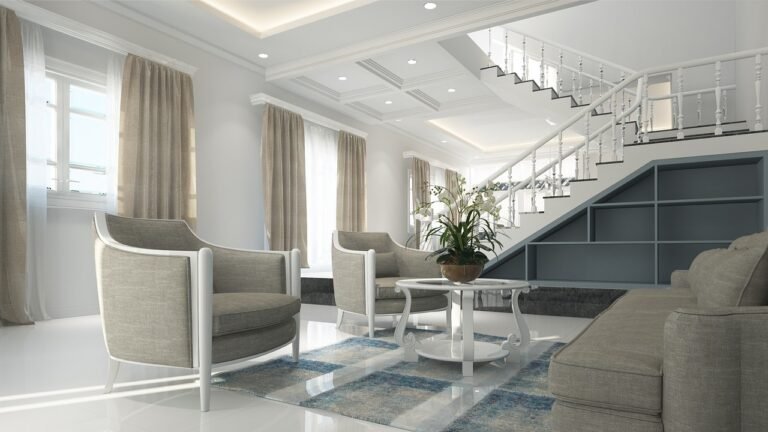
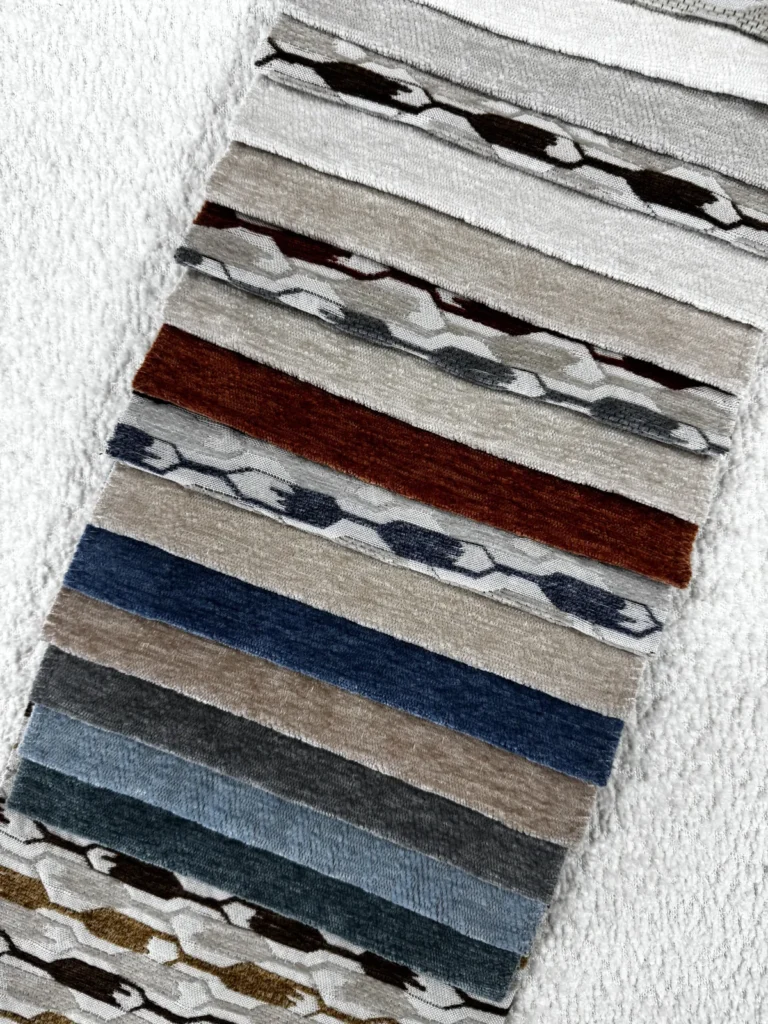
If your brief is a relaxed sofa with a visible textile surface, start by comparing a few chenille upholstery fabrics. Look at the texture from both close up and across the room. A small swatch can hide how prominent the weave will look over a whole seat or back.
If your buyer wants a smooth pile effect or a colour with more visual depth, compare velvet upholstery fabrics. Turn each sample under the same light and view it from different angles. Velvet’s pile direction can affect how it looks and feels; agree on the effect you want before cutting.
A useful sample brief: “We are developing a three-seat sofa in warm neutral colours. We want a soft feel, a subtle surface and fabric suitable for our upholstery process.” Add a reference image and the specifications you already know. This gives a supplier more to work with than “send your best fabric.”
Planning a chenille collection with both patterned and plain fabrics? Our guide to pairing jacquard and plain chenille for sofas uses the FL2606 series to show how to compare the two specifications, approve the colour pairing and plan quantities for each quality.
2. Compare the complete specification
Two fabrics with the same colour or GSM can still behave differently. Ask for the details of each shortlisted article:
- Article number and composition: identify the exact fabric and its fibre content.
- Weight and usable width: confirm GSM and the width your cutting team can actually use.
- Backing and finish: check the complete construction, not only the front surface.
- Direction or repeat: confirm how panels should be laid out.
- Care and testing information: request what your market and furniture application require.
Keep these details beside the physical sample. That makes it easier for your purchasing and production teams to compare the same article and avoid approving a colour while overlooking a construction difference.
3. Check cutting direction before calculating consumption
For velvet, mark the agreed pile direction on your approved sample and cutting plan. A panel turned the other way may look like a different shade even when it comes from the same fabric. Ask your upholstery team to review the seat, back and cushion layout together.
For chenille, check whether the selected weave, pattern or surface has a direction that should remain consistent. Do not assume every plain-looking fabric can be rotated freely.
There is no fixed extra allowance that suits every sofa. Calculate fabric consumption using your panel sizes, usable width, repeat and cutting layout. Compare the cost for the finished piece as well as the price per metre.
4. Ask for performance evidence for the article you choose
A heavier fabric is not automatically a better choice, and a soft feel is not a durability test. Tell your supplier whether the fabric is intended for residential sofas, a furniture retail collection or a project with specified testing requirements.
Depending on the application, discuss abrasion, pilling, seam behaviour, colourfastness and any required fire testing. Ask for the test method, result and report relevant to the selected article. Do not apply one fabric’s report to an entire collection.
The Association for Contract Textiles explains that higher abrasion numbers do not necessarily mean a longer fabric lifespan. Use abrasion results alongside other relevant properties, care instructions and the conditions of use.
5. Approve samples before committing to bulk
- Shortlist a few articles. Send reference photos, preferred colours, intended use and your estimated metres per colour.
- Compare physical samples. Review them in the same lighting, handle the fabric and check the front and back.
- Trial the chosen fabric. Discuss a suitable sample size for a sewing or upholstery trial with your production team.
- Record the approval. Keep the article number, colour reference, agreed specifications and approved sample together.
- Confirm the order details. Agree on quantity by colour, lead time, packing and any testing arrangements before production.
Common questions from fabric buyers
Is chenille cheaper than velvet?
There is no dependable price order across the two categories. Composition, construction, weight, backing, finish and order quantity all affect the quotation. Ask for comparable specifications and consider fabric consumption per finished sofa.
Can either fabric be described as washable or stain-resistant?
Only when that claim is supported for the selected article. Ask for confirmed care instructions and the details of any finish or testing. The words chenille and velvet do not establish those properties.
Can I request both types in one sample selection?
Yes. Tell us the look you want and the furniture you are making. We can discuss a focused selection of chenille and velvet so your team can compare the options side by side.
Need help choosing your next sofa fabric?
Send us a fabric photo or article number, your target market and estimated quantity. Huayeah Fabric can help you compare suitable options and confirm the specifications before you order.
Standard MOQ: 1,000–1,200 metres per design, per colour. Confirm the requirement for your chosen article. Fabric samples are free; courier charges collect.
Technical reading: ACT — understanding abrasion results; Fischbacher 1819 — velvet pile and direction. These references provide general background; they are not test reports for Huayeah Fabric products.