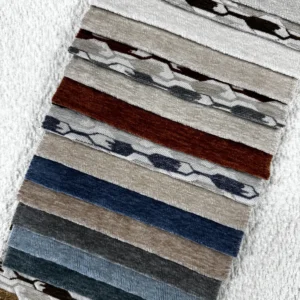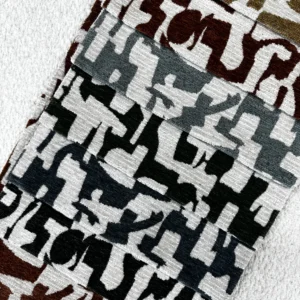
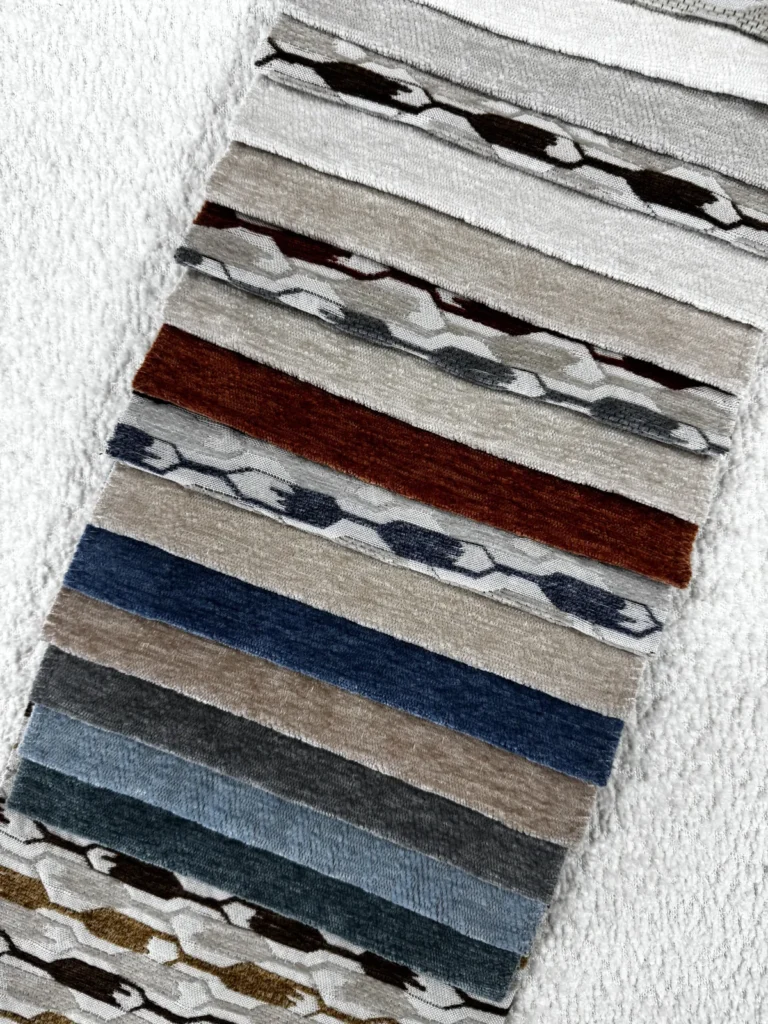
Pairing a patterned chenille with a coordinating plain fabric gives furniture buyers a way to build a collection around one design direction. The purchasing challenge is to keep the colours and appearance connected while treating each fabric as a separate production specification.
This guide uses the FL2606 coordinating chenille series as an example: a 370 GSM jacquard and a 270 GSM plain fabric, both 100% polyester and 145 cm wide. It is written for sofa manufacturers, furniture brands, importers and wholesalers planning bulk orders.
Start with the furniture layout
Before choosing colours, mark where each fabric will appear on the furniture drawing. A plain body with patterned cushions, a patterned accent chair alongside a plain sofa, or a combination of patterned and plain panels are possible directions. Treat these as design proposals until you have checked the fabrics on a sewn sample.
Give each panel a fabric code. This helps the sampling team, cutting room and purchasing department work from the same plan. Do not rely on a description such as “the matching beige” when several shades are under consideration.
One coordinated series, two separate specifications
| Specification | FL2606A-1 | FL2606B-1 |
|---|---|---|
| Fabric | Patterned chenille jacquard | Coordinating plain chenille |
| Composition | 100% polyester | 100% polyester |
| Weight | 370 GSM | 270 GSM |
| Width | 145 cm | 145 cm |
| Construction | Woven jacquard | Woven plain |
Specify A or B on every sample request, quotation and order line. The two weights describe different fabrics within the series; they are not alternative weights for the same fabric. Keep the selected colour reference and quantity alongside each code.
The weight difference is a reason to compare handle and sewing behaviour in sampling. It does not, by itself, establish which fabric is suitable for a particular seat, back or cushion. Ask for performance information relevant to the intended use instead of selecting by GSM alone.
Approve the colour pairing with physical samples
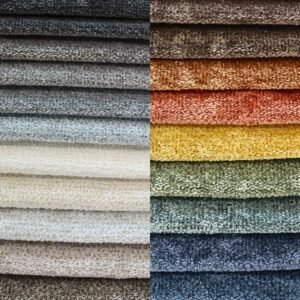
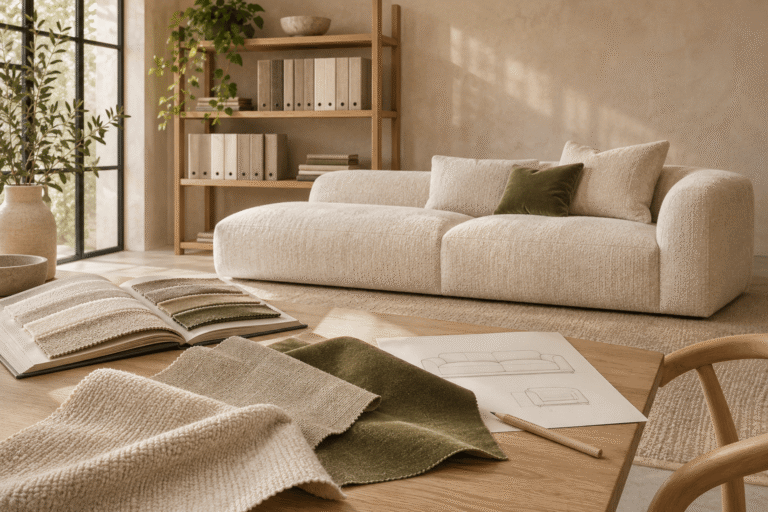
Use the colour card to shortlist combinations, then place the actual patterned and plain swatches side by side under the lighting used for your approval process. Check both the background tone and the accent colours. A plain fabric can coordinate with one colour in a pattern without being an exact match to its background.
Compare the samples in the intended cutting direction and on the proposed furniture shape. Agree whether your target is a close colour match or a deliberate contrast, and keep a labelled approval set for both fabrics. Website photographs are useful for selection, but should not be the final colour standard.
Check pattern placement before calculating metres
For the jacquard, request the horizontal and vertical pattern repeat and confirm the usable width. Then ask your cutting team to check how the design falls across seat cushions, arms, backs and adjoining seams. Decide which joins must match and where an interrupted motif is acceptable.
Calculate consumption for A and B separately from the approved cutting plan. Allow for pattern placement and the sample-room findings rather than applying a fixed waste percentage to every sofa. A change in cushion size or pattern position may change the required metres of the jacquard even when the sofa dimensions stay similar.
Review performance and sewing as a pair
Before a bulk commitment, request available test reports for each exact quality and confirm any additional testing needed for your market and furniture application. Review abrasion, pilling, colourfastness, seam behaviour and applicable flammability requirements with your quality team. Do not assume a report for the patterned fabric also covers its plain companion.
The Association for Contract Textiles explains that abrasion results alone do not predict fabric lifespan. Use test information alongside sample evaluation and construction checks, rather than treating one high abrasion number as a complete suitability assessment.
Make a sewn trial using the proposed foam, backing and seam construction. Check appearance at the joins, tension, shaping and the transition between the two fabrics. Record any backing or finishing requirement in the approved specification before ordering.
Build a clear quotation request
A useful RFQ separates the two qualities and gives enough information to price the actual collection:
- Fabric and colour: FL2606A-1 and FL2606B-1, with the selected colour references.
- Quantity: estimated metres for each quality and each colour, plus any repeat-order forecast.
- Furniture use: the panel layout, reference drawing or sample photograph.
- Technical requirements: agreed weight, width, backing, finish and testing requirements.
- Commercial details: destination market, required delivery timing and packing instructions.
Huayeah Fabric’s standard MOQ is 1,000–1,200 metres per design per colour. Confirm the requirement for each selected quality and colour when requesting a quotation; do not assume the patterned and plain quantities can be combined to meet one minimum. Fabric samples are free, with courier charges collect.
Compare other chenille jacquard designs
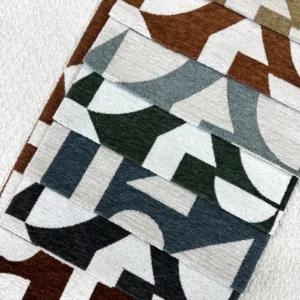
If your collection needs a different pattern direction, compare FL2618-5 abstract chenille jacquard and FL2616-6 geometric chenille jacquard. Both are listed as 100% polyester, 545 GSM and 148 cm wide. They are separate products, not confirmed matching companions for FL2606B-1.
Browse the chenille upholstery fabric collection to shortlist textures, then request samples of the combinations you want to assess.
Request a coordinated sample set
Send us your furniture layout and estimated metres per colour. Include “FL2606 A + B” in your enquiry so we can discuss the patterned and plain qualities together, confirm the specifications and prepare a sample selection for your team.